Key Takeaways
- A T2 is the corporate income tax return filed by most Canadian resident corporations
- A corporation generally must file even when it has no income or tax payable
- The filing deadline is generally six months after fiscal year-end
- Tax payment deadlines can occur earlier
- Most corporations must file electronically for tax years starting after 2023
- Required schedules depend on the corporation’s circumstances
- Good bookkeeping makes T2 preparation significantly easier
If you’ve just incorporated, or you’ve been running a corporation for a while and this is the first time you’re actually sitting down to figure out what your accountant keeps mentioning.
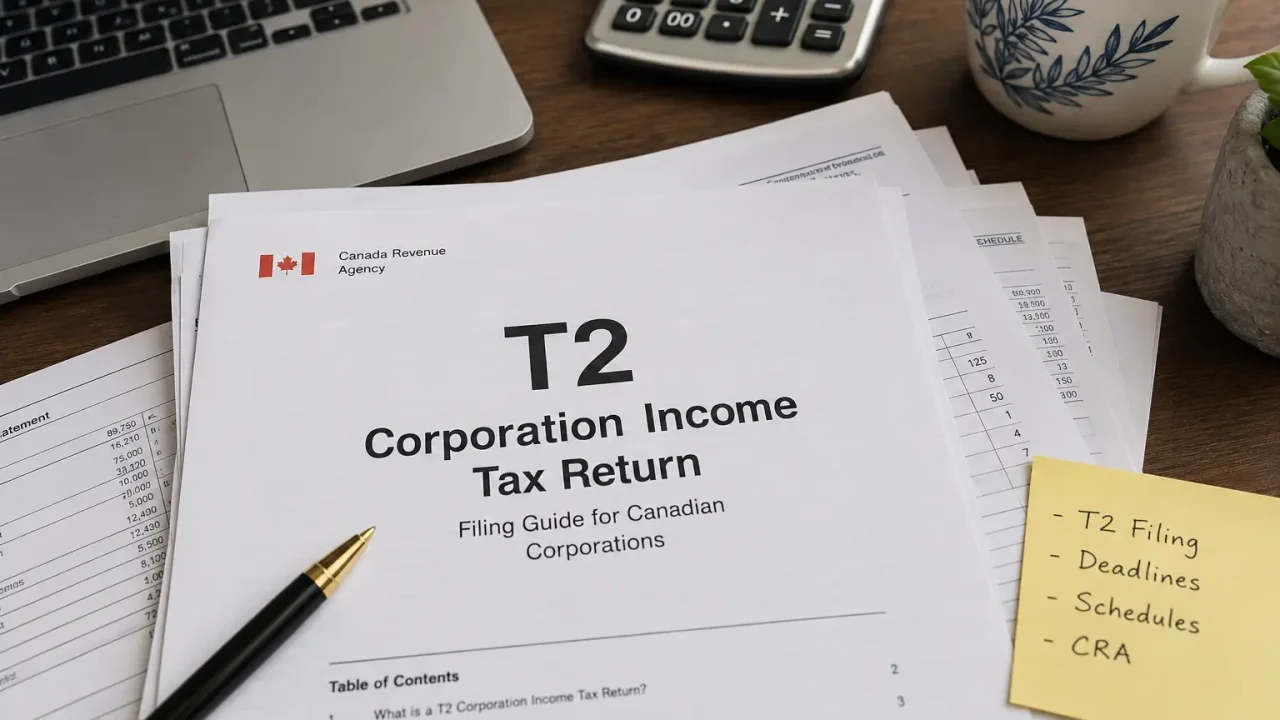
Most Canadian resident corporations have to file a T2 Corporation Income Tax Return every tax year, even if they have no income or tax payable.
That last part trips people up more than anything else. A lot of new business owners assume that a quiet year no sales, no expenses, nothing happening means nothing to report. It doesn’t work that way.
If your business is incorporated, the CRA expects a T2 form on file for that fiscal year, even if the number at the bottom is zero.
This guide walks through what the T2 actually is, who has to file it, when it’s due, what goes into it, and how to get it done without missing a step or a deadline.
What Is a T2 Corporation Income Tax Return?
A T2 corporation income tax return is the standard federal (and, in most provinces, combined federal-and-provincial) form that Canadian corporations use to report their income, calculate the tax they owe, and claim any deductions or credits they’re eligible for.
The T2 is the federal corporation income tax return and also covers provincial/territorial corporate income tax in most provinces and territories. Quebec and Alberta have separate provincial corporate income tax returns. CRA Source
It’s issued by the CRA and covers the corporation’s entire fiscal year, not the calendar year, which is one of the first things that surprises people coming from personal tax filing.
What is a T2 ? Think of it as the corporate equivalent of your personal T1. Where a T1 reports what an individual earned and owes, the T2 does the same job for a legal business entity the corporation itself, separate from you as the owner.
That separation matters: even if you didn’t pay yourself a dollar in salary or dividends during the year, the corporation still has to account for its own income and expenses on its own T2 tax return.
The federal T2 form is nine pages, but very few corporations submit only nine pages. Depending on what happened in the business that year, you’ll attach a set of supporting schedules more on that below.
T2 means: Corporation Income Tax Return
Filed with: CRA
Applies to: Most Canadian resident corporations
Filing frequency: Every tax year
Filing deadline: Six months after fiscal year-end
Balance-due date: Generally 2 months after year-end, or 3 months for eligible CCPCs
Electronic filing: Required for most corporations for tax years starting after 2023
T2 vs. T1: Key Differences
| Difference | T2 Corporation Income Tax Return | T1 Personal Income Tax Return |
|---|---|---|
| Who files it | The corporation, as a separate legal entity | Individuals, including business owners personally |
| Reporting period | Corporation’s fiscal year (can end on any date) | Calendar year (January 1 – December 31) |
| Filing deadline | 6 months after fiscal year-end | April 30 (June 15 if self-employed) |
| Required even with no income? | Yes a nil return is still mandatory | No not required below certain income thresholds |
| Form length | 9 pages, plus schedules | Varies by complexity |
| Return/Form | Used By | Purpose |
|---|---|---|
| T1 | Individual | Personal income tax |
| T2 | Corporation | Corporate income tax |
| T2125 | Self-employed individual | Business/professional income reported on T1 |
Important: T2125 is not a replacement for T2. An incorporated business generally deals with the corporation’s T2 separately from the owner’s personal T1.
Prefer to Have a Professional Handle Your T2?
Keep your focus on your business while Canadian tax professionals help prepare and file your corporate tax return, with support for bookkeeping, GST/HST, and CRA-related needs.
T2 vs. T2 Short Return
Not every corporation needs to file the full return. The T2 Short Return is a simplified, two-page version for corporations that meet a specific set of conditions:
| Requirement | T2 Corporation Income Tax Return | T2 Short Return |
|---|---|---|
| Corporation type | Any corporation | CCPC with nil income/loss, or exempt under section 149 |
| Provinces of operation | Any number | One province or territory only |
| Refundable tax credits | Can be claimed | Cannot be claimed |
| Taxable dividends | Can be paid or received | Cannot be paid or received |
| Currency | Canadian or functional currency | Canadian currency only |
| Form length | 9 pages | 2 pages plus one schedule |
If your corporation does not meet all of the CRA’s eligibility conditions, you must file the regular T2 Corporation Income Tax Return.
What Is a T2 Short Return?
The T2 Short Return is a simplified version of the T2 Corporation Income Tax Return available only to corporations that meet CRA eligibility conditions. It is not simply a shorter version that any small business can choose.
T2 vs Professional Accountant
| Situation | DIY / Software | Accountant Recommended |
|---|---|---|
| Inactive simple corporation | Possible | Optional |
| Simple single-owner corporation | Possible | Useful |
| GST/HST registered | Possible | Recommended if unsure |
| Salary + dividends | Possible but complex | Recommended |
| Shareholder loans | Riskier | Recommended |
| Investment income | Complex | Recommended |
| Multiple corporations | Complex | Strongly recommended |
| CRA review or audit | Possible but challenging | Strongly recommended |
| PSB concerns | No | Yes |
T2 vs Provincial Corporate Tax Returns
| Location | Federal Return | Provincial Corporate Return |
|---|---|---|
| Most provinces and territories | T2 | Generally handled through the T2 |
| Quebec | T2 | Separate Quebec corporate return |
| Alberta | T2 | Separate Alberta corporate return |
Who Needs to File a T2 Return?
| Situation | T2 Required? |
|---|---|
| Active Canadian corporation | Yes |
| Corporation with no revenue | Generally yes |
| Inactive corporation | Yes |
| Corporation with a tax loss | Yes |
| Non-profit organization | Generally yes |
| Tax-exempt corporation | Generally yes |
| Registered charity | No T2 under the general resident-corporation rule |
| Non-resident corporation | Depends on Canadian filing circumstances |
This is where most of the confusion lives, so let’s be direct about it.
Every resident corporation in Canada has to file a T2 return every tax year, regardless of activity level. That includes:
- Canadian-controlled private corporations (CCPCs) the category most small businesses and incorporated contractors fall into
- Non-profit organizations
- Tax-exempt corporations
- Inactive corporations yes, even if the company did absolutely nothing all year
The only real exceptions are tax-exempt Crown corporations, Hutterite colonies, and registered charities.
Non-resident corporations also have a filing obligation if they carried on business in Canada, realized a taxable capital gain, or disposed of taxable Canadian property during the year.
| Corporation Type | Must File a T2? |
|---|---|
| CCPC (active or inactive) | Yes |
| Non-profit organization | Yes |
| Tax-exempt corporation | Yes |
| Non-resident (business/gain/property in Canada) | Yes |
| Registered charity | No |
| Tax-exempt Crown corporation | No |
| Hutterite colony | No |
If your corporation sat dormant while you focused on something else, or you incorporated ahead of a project that hasn’t started yet, that still counts.
A nil return a T2 filed with no income and no tax owing is still a filing, and it still has a deadline. Skipping it because “there’s nothing to report” is one of the more common and more expensive mistakes incorporated business owners make, since the CRA can apply penalties and even move toward administrative dissolution for corporations that go silent for too long.
T2 Corporation Income Tax Return Deadline
The T2 filing deadline is based on your corporation’s tax year-end, not the calendar year. In general, a corporation must file its T2 Corporation Income Tax Return within six months after the end of its tax year. The date by which any balance owing must be paid can be earlier. Source
- Filing deadline: 6 months after the end of the fiscal year
- Payment deadline: 2 months after fiscal year-end for most corporations, or 3 months for CCPCs that meet certain conditions and earn active business income
Here’s how that plays out for a few common year-ends:
| Fiscal Year-End | Balance-Due Date* | T2 Filing Deadline |
|---|---|---|
| December 31 | March 31 | June 30 |
| March 31 | June 30 | September 30 |
| June 30 | September 30 | December 31 |
| September 30 | December 31 | March 31 (following year) |
These are two different dates. Your corporation may have additional time to file its T2 after the date its balance of tax is due. If tax is owing, paying it by the balance-due date helps avoid interest and potential penalties.
These examples use the general two-month balance-due rule. Eligible CCPCs may have a three-month balance-due period if they meet CRA’s conditions
Notice that the payment deadline almost always lands before the filing deadline. That catches people off guard you can technically have three or four extra months to file your paperwork, but the CRA still wants any tax owing paid on the earlier date, with interest accruing daily on anything paid late.
If a due date falls on a weekend or statutory holiday, it’s considered on time if it’s received or postmarked by the next business day.
Example: December 31 Year-End
If your corporation’s tax year ends on December 31, the general two-month balance-due date is March 31, while the T2 filing deadline is June 30. An eligible CCPC that meets CRA’s conditions may have a three-month balance-due date instead.
Is the T2 filing deadline the same as the corporate tax payment deadline?
No. The T2 filing deadline is generally six months after the corporation’s tax year-end, while the balance-due date is generally two months after year-end or three months for qualifying CCPCs. Source
What Documents Do You Need Before Filing?
You can’t complete an accurate T2 return without your books being in order first. At a minimum, you’ll need:
- Business Number (BN) : links the return to your CRA accounts
- Financial statements : a balance sheet and an income statement, prepared for the fiscal year
- GIFI codes : the General Index of Financial Information codes that map your financial statement line items to CRA’s standardized categories
- Revenue and expense records : invoices, receipts, bank statements
- Shareholder information : ownership percentages and details for Schedule 50
- Prior year’s T2 and Notice of Assessment : needed to carry forward balances like losses and CCA pools
This is usually where filing a T2 gets stressful, not because the form itself is complicated, but because the underlying records are scattered across a shoebox of receipts, three different bank accounts, and a spreadsheet nobody’s updated since spring.
Corporations that keep receipts, mileage, and GST/HST tracked as the year goes rather than reconstructing it all in May consistently spend less time and pay less to have their T2 prepared.
How Much Does a T2 Corporation Tax Return Cost?
| Corporation Situation | Typical Complexity |
|---|---|
| Inactive / very simple corporation | Low |
| Single-owner service corporation | Low–Moderate |
| Incorporated contractor with GST/HST | Moderate |
| Corporation with payroll | Moderate |
| Multiple shareholders | Moderate–High |
| Investment income | High |
| Multiple corporations | High |
| Foreign assets/transactions | High |
T2 Schedules Explained
The base T2 form is really a summary. The schedules are where the actual detail lives, and which ones apply to you depends on your corporation’s activity during the year.
| Schedule | What It Covers |
|---|---|
| Schedule 100 | Balance sheet information (assets, liabilities, equity) |
| Schedule 125 | Income statement information (revenue and expenses) |
| Schedule 50 | Shareholder information and ownership percentages |
| Schedule 1 | Reconciles net income per financial statements to net income for tax purposes |
| Schedule 8 | Capital Cost Allowance (CCA) depreciation on business assets |
| Schedule 4 | Loss carry-forwards and carry-backs |
| Schedule 7 | Small business deduction calculation |
| Schedule 141 | Notes checklist / financial statement notes information |
Many small CCPCs may need schedules such as 100, 125, 50, 1 and 8, but the schedules required for a particular corporation depend on its activities, financial statements and tax circumstances.
Larger or more complex corporations multiple provinces, subsidiaries, investment income will need additional schedules on top of these.
How to File a T2 Corporation Income Tax Return
Once your records are ready, the process itself follows a fairly predictable sequence:
- Prepare your financial statements. Your income statement and balance sheet form the foundation everything else is built on.
- Calculate net income for tax purposes. This isn’t the same number as your accounting net income you’ll add back non-deductible expenses (like the portion of meals and entertainment over the 50% limit), swap accounting depreciation for CCA, and apply any available small business deduction.
- Complete the return and required schedules, using your GIFI codes to map financial statement data into the CRA’s format.
- Review everything against your supporting records before submitting mismatches between your financial statements and your schedules are one of the more common triggers for a CRA review.
- File electronically. For tax years starting after 2023, corporations generally have to file their T2 electronically. Exceptions include insurance corporations, non-resident corporations, corporations reporting in functional currency, and corporations exempt from tax under section 149 of the Income Tax Act. A $1,000 penalty may apply when a corporation that is required to file electronically does not comply.
- Pay any balance owing by the payment deadline, separately from the filing deadline.
- Keep your records. The CRA requires supporting documentation to be retained for at least six years in case of a review.
Can You File Your Own T2 Return?
Yes for a straightforward, single-province CCPC with clean books and no complicated income sources, filing your own T2 is realistic, especially with CRA-certified software walking you through the schedules.
Where it gets riskier is anything involving multiple provinces, investment income, shareholder loans, or capital gains situations where a small misclassification can trigger a reassessment.
Plenty of incorporated contractors and small business owners handle the bulk of their own bookkeeping throughout the year, then either file the T2 themselves using certified software or hand a clean, organized set of records to an accountant for the final review.
That second approach tends to be the sweet spot: it keeps costs down without leaving accuracy to chance, since the accountant isn’t starting from a pile of unsorted receipts.
10 Common T2 Corporation Income Tax Return Mistakes
For example:
- Assuming a corporation with no income doesn’t need to file
- Confusing the T2 deadline with the tax payment deadline
- Using the wrong fiscal year-end
- Missing required schedules
- Poor GIFI classification
- Mixing personal and corporate expenses
- Failing to reconcile bank accounts
- Mishandling shareholder loans
- Forgetting GST/HST reconciliation
- Filing electronically when an exception applies—or failing to comply with mandatory electronic filing
Where to Send or File Your T2 Return
Electronic filing through CRA-certified software or Corporation Internet Filing is the standard route now, and it’s mandatory for most corporations.
If your corporation is one of the limited exceptions still filing on paper insurance corporations, non-resident corporations, corporations reporting in functional currency, or those exempt under section 149 your mailing address depends on where the corporation is located, with returns routed to one of the CRA’s regional tax centres.
The CRA’s own site lists the correct tax centre by province, so it’s worth checking there directly rather than guessing, since sending it to the wrong office just adds delay.
| Filing Method | Who It Applies To | Notes |
|---|---|---|
| Electronic (Corporation Internet Filing) | Mandatory for most corporations, tax years starting after 2023 | Fastest processing, immediate confirmation |
| Paper filing | Insurance corporations, non-resident corporations, functional-currency filers, section 149 exempt corporations | Mailed to the CRA tax centre for your province |
Penalties for Late or Missed T2 Filing
Missing the deadline isn’t a quiet mistake the CRA’s penalty structure is built to make it expensive quickly:
| Situation | Potential Consequence |
|---|---|
| Late T2 with unpaid tax | 5% of unpaid tax + 1% per complete month, up to 12 months |
| Certain repeated late filings | Higher penalty may apply |
| Required electronic filing not completed electronically | $1,000 penalty may apply |
| Failure to file | Additional CRA compliance consequences may apply |
CRA currently explicitly says the electronic-filing non-compliance penalty is $1,000. CRA Source
- Late-filing penalty: 5% of the unpaid tax, plus 1% for every full month the return is late, up to a maximum of 12 months
- A corporation can still face filing consequences even when it has no tax payable. The standard late-filing penalty is generally based on unpaid tax, while specific failure-to-file penalties can apply in other circumstances.
- Arbitrary assessments. If the CRA doesn’t have a return on file, they can estimate what your corporation owes based on prior filings or industry data, and that estimate is rarely in your favour
- Ongoing non-compliance can eventually lead to administrative dissolution, making it harder to revive the corporation later
If you’ve fallen behind on filings, the fix isn’t to wait until everything feels “ready” it’s to file what’s outstanding as soon as your records allow, since penalties compound the longer a return sits unfiled.
T2 Corporation Tax Return Checklist
| Before Filing | Check |
|---|---|
| Business Number | ✓ |
| Fiscal year-end | ✓ |
| Income statement | ✓ |
| Balance sheet | ✓ |
| Bank reconciliation | ✓ |
| GST/HST records | ✓ |
| Payroll records | ✓ |
| Shareholder information | ✓ |
| Capital assets / CCA | ✓ |
| Previous T2 / NOA | ✓ |
| Required schedules | ✓ |
| Tax payment | ✓ |
| Electronic filing eligibility | ✓ |
T2 Corporation Income Tax Return: FAQs
What is a T2 Corporation Income Tax Return?
It’s the annual return every resident Canadian corporation files with the CRA to report income, calculate tax payable, and claim deductions or credits required even if the corporation had no income or activity during the year.
What is the filing deadline for T2 corporate tax returns in Canada?
Six months after the corporation’s fiscal year-end. Any tax owing is generally due earlier two months after year-end, or three months for eligible CCPCs.
Can I file my own T2 return?
Yes, for straightforward CCPCs with organized records. More complex corporate structures usually benefit from professional review.
| Corporation Situation | DIY Difficulty |
|---|---|
| Nil/inactive | Low |
| Simple CCPC | Moderate |
| GST/HST + expenses | Moderate |
| Salary/dividends | High |
| Shareholder loans | High |
| Multiple corporations | High |
| Investment income | High |
| Foreign transactions | High |
| CRA review | Very High |
Do inactive corporations need to file a T2?
Yes. Inactive status doesn’t remove the filing requirement a nil return still needs to be filed by the standard deadline.
Where do I mail my T2 return?
Most corporations must file electronically. Paper filing is available only to corporations that fall within CRA’s exceptions to mandatory electronic filing.
What is the T2 Short Return?
A simplified, two-page version of the T2 for eligible CCPCs with nil income or a loss, operating in a single province, with no refundable credits or taxable dividends.
What Happens After You File a T2?
T2 submitted → CRA processes return → assessment → Notice of Assessment → balance/refund → records retained
How Long Should I Keep T2 Records?
CRA says corporate information slips, receipts and papers should generally be kept for at least six years. CRA Source
Keep Your Books T2-Ready All Year, Not Just at Filing Time
The part of T2 filing that actually eats up time and money almost never happens on the form itself it happens beforehand, tracking down receipts, reconciling GST/HST, and figuring out which trips were actually business mileage.
Corporations that stay organized throughout the year walk into filing season with clean numbers instead of a scramble.
That’s the gap Zoombooks was built to close for Canadian contractors, consultants, and incorporated small business owners: capture receipts as they happen, track income, expenses, GST/HST, and mileage in one place, and generate accountant-ready reports when it’s time to file so your T2 return starts from organized records instead of a shoebox.
Keep Your Books T2-Ready All Year
Keep your income, expenses, receipts, GST/HST, and mileage organized throughout the year with Zoombooks so your T2 filing starts with clean, accountant-ready records.
When You’d Rather Have a Professional File It: Instaccountant
Organized books get you most of the way there, but not every corporation wants to prepare and submit the T2 itself and for anything beyond a simple, single-province CCPC, that’s a reasonable call. Zoombooks is built by Instaccountant, a team of Canadian accountants who work specifically with incorporated contractors, consultants, and small business owners on:
- T2 corporate income tax filing
- GST/HST registration, filing, and input tax credit review
- Salary vs. dividend planning for incorporated contractors
- CRA audit support and Personal Services Business (PSB) risk review
- Full-cycle bookkeeping and payroll
If you’re using Zoombooks to keep your records organized through the year, that same data hands off cleanly to Instaccountant when it’s time to file so you’re not paying someone to untangle your books before they can even start on the return.
Whether you’re preparing your T2 yourself or prefer professional help, the first step is having clean, organized business records. Use Zoombooks app to keep your income, expenses, receipts, GST/HST, and mileage organized throughout the year or connect with Instaccountant when you want professional corporate tax support.
This article is intended for general information and does not replace professional tax advice.
Written by Murtaza,
Murtaza is a seasoned accountant with over a decade of experience, guiding Canadian corporations, contractors, and small businesses through bookkeeping, compliance, and financial planning.
Official CRA Resources
Link to: