10 Small Business Bookkeeping Mistakes by Contractors (2026)
By
Zoombooks
Most Canadian contractors and independent consultants do not struggle with bookkeeping because they lack income they struggle because bookkeeping gets pushed behind client work, job sites, invoices, and daily business decisions.
That delay can create small business bookkeeping mistakes that become expensive later: missing receipts, mixed personal and business expenses, forgotten GST/HST details, incomplete mileage records, and books that only get attention when tax season arrives.
The good news is that you do not need to become an accountant to avoid these problems. A simple year-round routine can keep your records organized, preserve supporting documents, track tax-related information, and make tax preparation much easier.
Below are the most common bookkeeping mistakes we see in Canadian small businesses, contractors, and consultants and the practical way to prevent them. For a broader introduction to maintaining organized records, see our small business bookkeeping guide in Canada.
The Two Common Tax Paths for Canadian Contractors
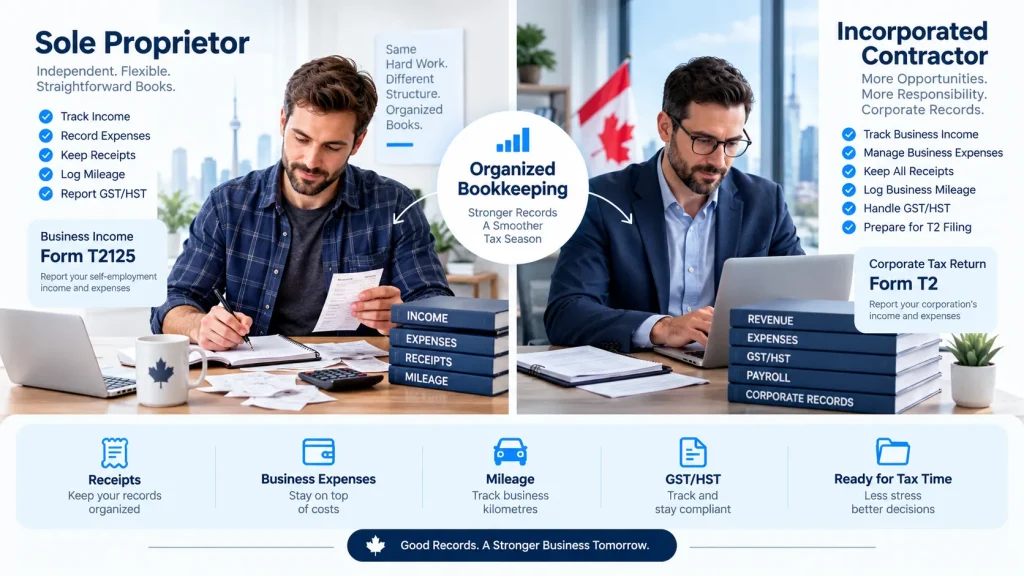
Canadian contractors generally operate as either a sole proprietorship or a corporation. The bookkeeping habits are similar in both cases, but the tax reporting is different.
Sole Proprietor
Corporation
Business income is generally reported on your personal return using Form T2125.
Corporate income is reported through a T2 Corporate Income Tax Return.
Personal and business transactions should still be kept clearly separate.
Corporate and personal finances should be kept strictly separate.
GST/HST tracking may apply if registered.
GST/HST tracking may apply if registered.
Sole proprietors and corporations have different tax reporting paths, but both need organized business records.
The important point is simple: clean records matter in both structures. You do not need advanced accounting knowledge you need a consistent system for capturing income, expenses, receipts, mileage, and tax information throughout the year.
4 Simple Habits That Prevent Most Bookkeeping Mistakes
1. Keep business and personal spending separate 2. Capture receipts as you make purchases 3. Record business mileage as you drive 4. Review your books every month
Now let’s look at the bookkeeping mistakes these four habits help prevent.
Mistake 1: Relying on Bank and Credit Card Statements as “Proof of Expense”
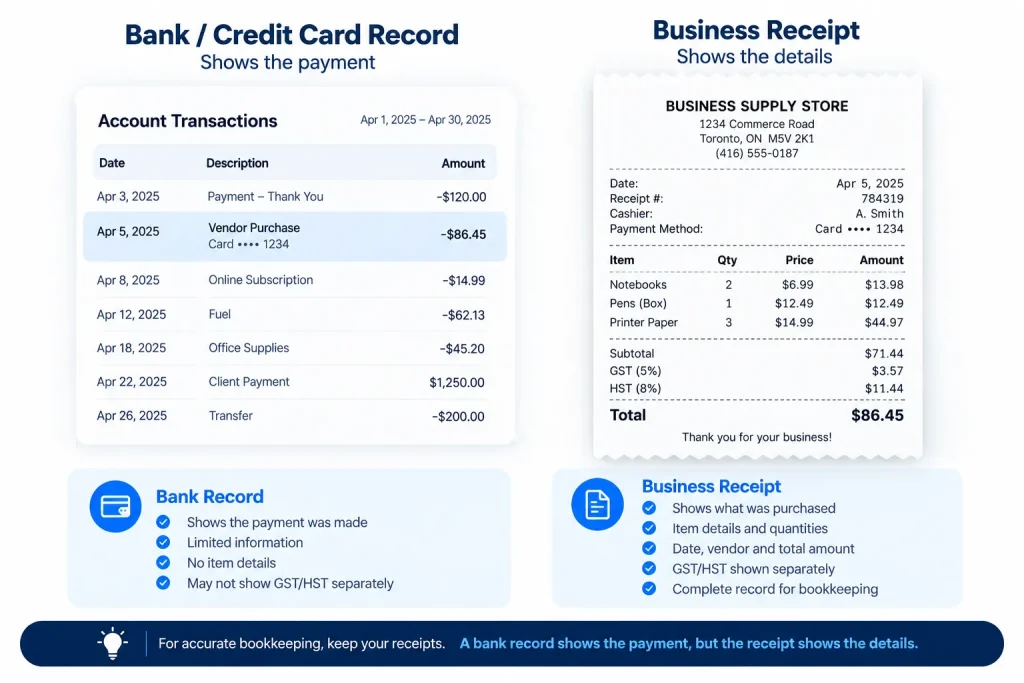
A bank or credit-card statement can show that money left your account, but it may not contain enough information to support the underlying business expense. A receipt or invoice usually provides the important details your records need what you purchased, when you purchased it, who supplied it, and how much GST/HST was charged.
The safest approach is to keep both the payment record and the supporting receipt or invoice.
The Reality of a CRA Desk Audit
A bank or credit card statement only proves that money left your account on a specific date. It is an electronic record of payment, not a legal record of supply.
When a CRA auditor issues a formal Request for Information (RFI) for Form T2125 or corporate Schedule 125, they require evidence establishing that the expense was incurred strictly to earn commercial income. A bank statement cannot answer that question.
Think of your bank statement as evidence that the payment happened and your receipt or invoice as evidence of what the payment was for.
A payment record shows that money moved; the supporting receipt helps document what the business actually purchased.
The 3 Mandatory Items Missing from Financial Statements
To satisfy CRA evidentiary standards under the Income Tax Act and the Excise Tax Act, your supporting documentation must provide data points that a monthly bank summary cannot supply:
Itemized Supply Breakdown: A $350 debit at Home Depot or Canadian Tire on a bank feed does not show whether you bought framing lumber and electrical conduit or personal home decor. Without a line-by-line itemized description, the CRA can classify the transaction as personal and disallow the entire claim.
For GST/HST claims: The supporting invoice or receipt needs to contain the information required for the transaction. Documentation requirements increase as the value of the purchase increases, so keeping complete receipts and invoices is much safer than relying on a bank transaction alone.
Explicit GST/HST Breakout: Bank feeds show a single lump-sum total. They do not separate provincial sales tax, zero-rated items, or standard 5%, 13%, or 15% sales tax rates.
The Statutory 6-Year Record Retention Rule
Under subsection 230(4) of the Income Tax Act, you are legally obligated to maintain books, records, and original source documents for a minimum of six years from the end of the last tax year to which they relate.
CRA generally requires businesses to keep supporting tax records for six years from the end of the last tax year they relate to. See the CRA record-keeping requirements for the official guidance. That can include receipts, invoices, bank records, contracts, and other documents supporting your income and expenses. Digital copies can make this much easier because they remain searchable, organized, and accessible when needed.
The Actionable Fix: Point-of-Purchase Digital Receipt Capture
Under CRA guidelines on electronic record-keeping, digital copies of paper receipts are legally acceptable as primary source documents, provided the scanned images are clear, legible, and produced in a standard format upon request.
To eliminate audit risk:
Capture at the point of sale: Take a digital photo of paper slips immediately in your vehicle before leaving the supplier parking lot.
Preserve metadata: Ensure the capture tool extracts the vendor name, date, subtotal, sales tax (GST/HST), and total amount.
Maintain cloud redundancy: Store receipts in a CRA-compliant system rather than a personal photo gallery, keeping itemized proof organized and accessible for the mandatory six-year window.
Mistake 2: Mixing Personal and Business Finances (The Commingling Trap)
Using a single personal credit card or debit card for company supplies, fuel, household groceries, and streaming subscriptions is one of the fastest ways to compromise your financial records.
Many contractors start out using one account because it feels simpler in the early stages. However, as transaction volume grows, combining personal and business spending creates a severe financial blind spot. By year-end, what seemed like a minor shortcut turns into an expensive accounting clean-up project that weakens your tax deductions and invites scrutiny from the Canada Revenue Agency (CRA).
The One-Card Dilemma
When personal and commercial transactions flow through the same account, every single purchase must be manually reviewed, verified, and separated at tax time.
Sole Proprietor Impact (Form T2125)
For unincorporated sole proprietors, commingled accounts create two immediate financial risks:
Unclaimed Write-Offs: Legitimate business expenses paid with personal funds get buried beneath personal transactions. If you forget to claim eligible materials, digital tools, or fuel purchases, you directly overpay your income tax and Canada Pension Plan (CPP) contributions.
Gross Negligence Penalties: If personal purchases (such as family dinners or home supplies) are claimed as business deductions on Form T2125 (Statement of Business or Professional Activities), the CRA can treat the error as gross negligence under Subsection 163(2) of the Income Tax Act. This penalty equals 50% of the understated tax, on top of back-taxes and compounding daily interest.
For Incorporated Contractors: Personal Spending Can Create Shareholder Problems
A corporation is legally separate from you personally. When corporate funds are regularly used for personal purchases, those transactions need to be recorded correctly rather than treated as business expenses.
Depending on the circumstances, personal withdrawals can create a shareholder loan balance and may have personal tax consequences if they are not handled properly.
The practical fix is simple: keep personal spending out of the corporate account and make salary, dividend or reimbursement transactions clearly documented.
The Actionable Fix: Establish Clean Separation and Pay Structures
Stopping the financial bleeding requires a clear boundary between your business entity and your personal household finances.
Open Dedicated Commercial Accounts: Set up a dedicated business chequing account and business credit card immediately. Route 100% of client invoices, contracts, and vendor payments through these accounts exclusively.
Sole Proprietor Pay Structure: Pay yourself by making a single, clean electronic transfer from your business chequing account to your personal account labeled as an Owner Equity Draw.
Incorporated Pay Structure: Pay yourself strictly through structured payroll salary (with proper source deductions and annual T4 filings) or documented shareholder dividends (with T5 information returns).
Handling Out-of-Pocket Business Purchases: If you must use a personal card for a business purchase in an emergency, keep the itemized receipt, submit a simple expense reimbursement claim, and transfer the exact dollar amount from your corporate bank account back to your personal account.
Mistake 3: Forgetting to Track and Claim GST/HST Input Tax Credits (ITCs)
One common problem is treating GST/HST as something you only need to think about when a return is due. The real issue is that you may be collecting GST/HST from clients while also paying GST/HST on eligible business purchases and if your records are incomplete, it becomes difficult to know your true net tax position.
That can lead to missed Input Tax Credits (ITCs), unexpected remittances, and unnecessary cash-flow pressure at filing time.
When you are registered for GST/HST, every dollar of sales tax you pay on business-related expenses is not an operational loss. It is an Input Tax Credit (ITC) that provides a dollar-for-dollar reduction against the sales tax you owe to the government.
The Small Supplier Threshold ($30,000 CAD) and the Rolling 4-Quarter Rule
Under CRA guidelines, you must register for a GST/HST account once you exceed the small supplier threshold of $30,000 CAD in gross taxable revenue.
A critical compliance error is assuming this threshold resets on January 1 of every year.
The CRA calculates the $30,000 limit across a single calendar quarter or over four consecutive calendar quarters (a rolling 12-month period).
The Single-Quarter Spike: If your business bills $32,000 in a single calendar quarter, you stop being a small supplier immediately on the day the transaction occurred. You must register and begin charging GST/HST on the very invoice that pushed you over the limit.
The 4-Quarter Accumulation: If your gross revenue gradually crosses $30,000 across four consecutive calendar quarters, you cease being a small supplier at the end of the month following that fourth quarter.
CRA Small Supplier Threshold Rules
Registration Requirement
Cross $30,000 in 1 Quarter
Register immediately on the specific transaction invoice
Cross $30,000 in 4 Quarters(Rolling 12-month period)
Register by the end of the month following Quarter 4
If you miss this threshold and fail to register, the CRA will retroactively assess the sales tax you should have charged. Because you cannot easily re-invoice past clients for uncollected tax months later, that unremitted GST/HST comes directly out of your own profit margin.
The ITC Mechanics Across Canadian Provinces
For current documentation requirements, see the CRA GST/HST records guidance. As a registrant, the federal and harmonized tax components of those payments are 100% recoverable as ITCs.
The exact rate of recoverable tax depends on the province of supply:
5% GST Provinces: Alberta, British Columbia, Saskatchewan, Manitoba, Yukon, Northwest Territories, and Nunavut. (In provinces with Provincial Sales Tax like BC, SK, and MB, only the 5% federal GST qualifies as an ITC; the PST portion is deducted as an operating expense on your income tax return).
13% HST: Ontario.
15% HST: Nova Scotia, New Brunswick, Prince Edward Island, and Newfoundland and Labrador.
Quebec (GST + QST): 5% GST + 9.975% QST. Under Revenu Québec regulations, registered businesses claim Input Tax Credits for GST and Input Tax Refunds (ITRs) for QST.
The “Lump-Sum” Expense Error: Why Spreadsheets Bleed Cash
Contractors who track expenses using basic spreadsheets or personal budgeting apps frequently commit the lump-sum logging error.
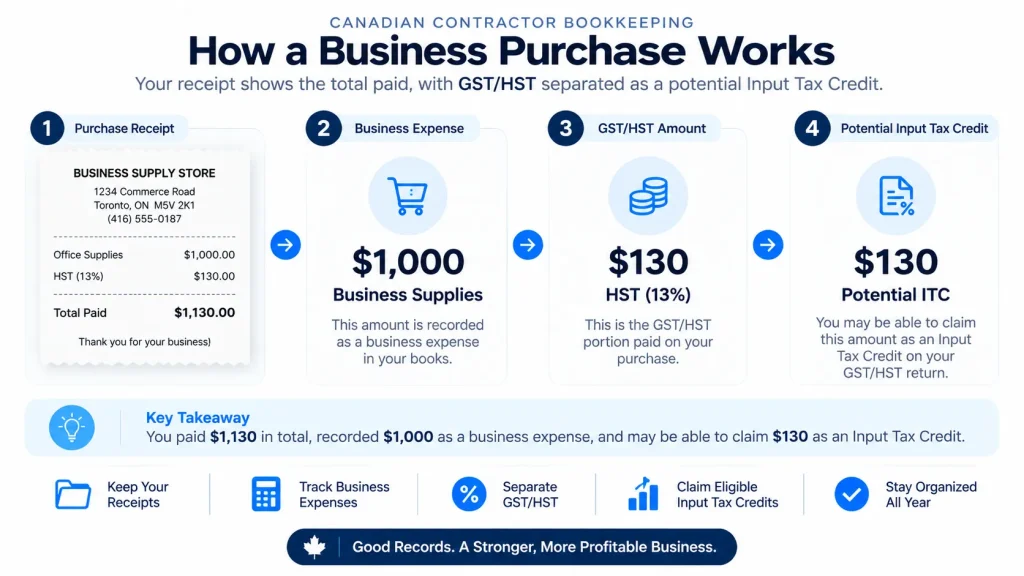
When purchasing $1,000 in electrical supplies in Ontario, the total receipt comes to $1,130 CAD ($1,000 materials + $130 HST). In a spreadsheet, the contractor enters “$1,130” into a single “Materials” column.
At year-end, that $1,130 is claimed as a standard income tax deduction on Form T2125 or corporate Schedule 125. While this reduces taxable business income, it completely forfeits the $130 direct cash credit on the GST/HST return.
Tracking GST/HST paid on eligible purchases helps Canadian businesses understand their potential Input Tax Credits.
Simple Example
You buy $1,000 of business supplies in Ontario
and pay $130 HST.
Total Paid
$1,130 CAD
Business Expense Before HST
$1,000 CAD
HST Paid
$130 CAD
Potential Input Tax Credit (ITC)
$130 CAD
Recording only the $1,130 CAD total can make it
harder to identify the GST/HST portion when you prepare your return.
Keeping the expense and tax components organized throughout the year
helps you see your actual GST/HST position more clearly.
The Actionable Fix: Real-Time Pre-Tax and Sales Tax Transaction Splitting
To ensure you never leave money on the table or face penalties during a sales tax audit:
Split Every Transaction Instantly: Never record an expense as a single gross total. Break every transaction into its Net Subtotal + GST/HST Paid.
Verify Vendor Business Numbers: Ensure every receipt for expenses over $30 displays the supplier’s 9-digit CRA Business Number (e.g., 123456789 RT0001). Without this number on the source receipt, the CRA will disallow the ITC during a desk audit.
Monitor Net Sales Tax Position Monthly: Calculate (GST/HST Collected) - (ITCs Paid) continuously throughout the year. Knowing your exact net remittance balance prevents year-end cash flow emergencies when your CRA return is due.
Mistake 4: Estimating Vehicle Mileage Instead of Keeping a CRA Logbook
For Canadian contractors, tradespeople, and mobile consultants, motor vehicle expenses represent one of the most substantial tax deductions available on Form T2125 (Line 9281) or corporate Schedule 125 (GIFI 8810).
Because vehicle expenses are so large, they are also among the most heavily scrutinized and audited line items by the Canada Revenue Agency (CRA).
A common bookkeeping mistake among self-employed individuals is estimating their vehicle claim at tax time. Many business owners assume that claiming a standard percentage such as “I use my truck 80% for work” is acceptable as long as they retain their fuel and repair receipts.
A rough estimate such as “I use my vehicle about 80% for work” is not a substitute for a proper mileage record. Your vehicle claim should be supported by records showing the business kilometres you drove and the total kilometres driven during the year.
The CRA Scrutiny Factor: How Vehicle Audits Work
In Canada, self-employed individuals cannot simply claim a flat per-kilometer rate for business driving on their tax return (the CRA prescribed per-kilometer automobile allowance is designed for employee reimbursements, not self-employed business deductions).
Instead, contractors must track all actual vehicle operating costs including fuel, insurance, maintenance, license fees, commercial leasing costs, or loan interest and multiply that total by their verifiable business-use percentage:
$$\text{Allowable Vehicle Deduction} = \text{Total Vehicle Operating Expenses} \times \left( \frac{\text{Total Business Kilometres Driven}}{\text{Total Kilometres Driven in Fiscal Year}} \right)$$
If you cannot prove both the numerator (business travel) and the denominator (total driving) with verifiable odometer readings, your claim cannot be defended.
The 4 Non-Negotiable Data Points Every CRA Auditor Demands
According to CRA administrative guidelines (Guide T4002 and Interpretation Bulletin IT-521), a valid motor vehicle logbook must record four specific details for every single business trip:
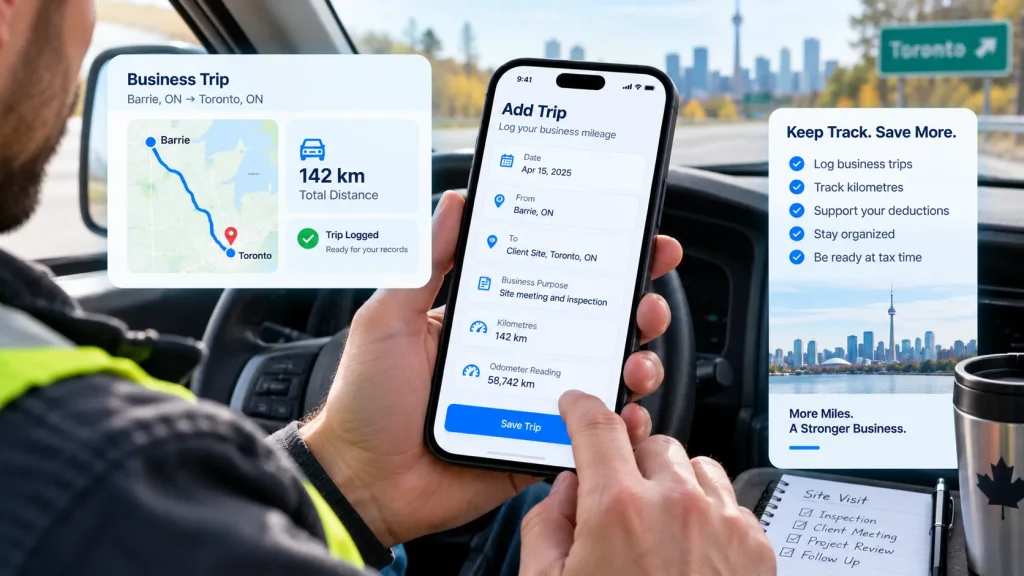
A proper mileage log records the key details needed to support business vehicle use.
Date of the Trip: The exact calendar day the travel occurred.
Destination Address: The physical site, client office, or vendor location visited.
Specific Commercial Purpose: A clear business justification (e.g., “Emergency electrical rough-in – 450 Bay St” or “Material pickup – Home Hardware Mississauga”). Vague entries like “Client meeting” or “Work errands” are routinely rejected during desk reviews.
Distance Driven: The exact number of kilometers traveled for that specific trip.
In addition to individual trip entries, you should maintain your vehicle’s total odometer readings at the start and end of the fiscal year. See the CRA motor vehicle records guidance for the official record-keeping requirements.
The Commute Fallacy: What Counts as Business Driving?
A frequent point of confusion for independent contractors is classifying normal commuting as business mileage.
Under Canadian tax law, driving from your personal residence to a regular, fixed place of business or primary office is considered personal travel.
CRA Travel Classification Rules
Classification
Home → Regular Office(Fixed daily workplace)
❌ PERSONAL COMMUTENon-deductible
Home Office → Client Site(Designated principal office)
✅ BUSINESS TRAVEL100% Deductible km
Job Site A → Job Site B(Inter-site transit)
✅ BUSINESS TRAVEL100% Deductible km
Supplier → Client Property(Material supply run)
✅ BUSINESS TRAVEL100% Deductible km
If your home qualifies as your Principal Place of Business under CRA rules (i.e., where you conduct administrative management, store tools, and generate billing), trips starting from your home directly to customer job sites, trade suppliers, or client consultations qualify as 100% deductible business travel.
The Actionable Fix: Mobile, Trip-by-Trip Digital Logging
Paper logbooks kept in glove compartments are almost universally abandoned by month two. Reconstructing twelve months of driving at tax time using Google Maps timelines is exhausting and frequently results in errors that raise audit flags.
To keep your motor vehicle deductions audit-proof:
Record Trips Digitally at the Point of Parking: Use a mobile app that allows you to log the trip destination, purpose, and kilometers in under 10 seconds right when you turn off the vehicle.
Capture Annual Odometer Checkpoints: Take a photo of your vehicle dashboard odometer on January 1 and December 31 of each year.
Link Mileage to Expense Claims: Ensure your annual business-use ratio is automatically calculated against your fuel, insurance, and maintenance receipts, so your accountant has a verified percentage ready for Form T2125 or corporate GIFI reporting.
Mistake 5: Expensing Capital Equipment as Operating Costs (CCA Errors)
When a contractor purchases a $3,500 MacBook Pro, a $2,800 commercial table saw, or a $45,000 cargo van, the natural instinct is to write off the entire invoice against this month’s revenue.
Recording high-value equipment purchases as everyday operating expenses such as dumping them under “Office Supplies,” “Tools,” or “Repairs & Maintenance” is a major bookkeeping mistake that distorts your financial statements and triggers immediate adjustments during a Canada Revenue Agency (CRA) review.
The CRA strictly distinguishes between current operating expenses (which are fully deductible in the year they occur) and capital expenditures (which must be capitalized as assets on your Balance Sheet and depreciated over several years).
Current Expenses vs. Capital Assets: The CRA Test
To determine whether a purchase is an immediate write-off or a long-term capital asset, the CRA evaluates three primary criteria:
Lasting Benefit: Does the item provide an enduring economic benefit beyond the current tax year? Consumable items like sandpaper, drill bits, or printer toner are used up quickly (current expense). A laptop, diagnostic scanner, or utility trailer will generate income for years (capital asset).
Maintenance vs. Betterment: Does the expenditure maintain an existing asset in its normal working state, or does it substantially improve the asset beyond its original condition? Replacing brake pads on your work truck is a current repair expense; replacing the entire engine or installing a custom commercial utility body is a capital expenditure.
Type and Cost of the Property: CRA treatment depends on what the asset is and how it is used. Certain small tools have specific CCA treatment, while computers, vehicles, machinery and other assets may fall into different classes. Do not use one universal dollar threshold for every purchase.
Core CRA CCA Asset Classes for Canadian Contractors
Capital assets cannot be written off all at once because their value depreciates over time. Instead, you claim Capital Cost Allowance (CCA) annually based on specific prescribed percentage rates assigned by the CRA:
Tax Incentive Awareness: The Accelerated Investment Incentive (AII) and Half-Year Rule
When claiming CCA in standard tax years, the CRA enforces the Half-Year Rule (50% Rule): in the year you buy an asset, you can only claim CCA on half of the net addition cost.
However, Canadian contractors should be aware of the Accelerated Investment Incentive (AII). The AII effectively suspends the restrictive half-year rule for eligible capital property, providing an enhanced first-year deduction:
For Class 50 (Computers): The AII allows a first-year write-off rate of up to 82.5% ($55\% \times 1.5$) of the asset cost in Year 1.
For Class 8 (Tools & Equipment): The first-year deduction jumps from a standard 10% (half of 20%) to 30% ($20\% \times 1.5$).
For Class 10 (Commercial Vehicles): The first-year deduction increases to 45% ($30\% \times 1.5$).
Expensing these purchases incorrectly under general supply accounts completely bypasses the legal CCA framework, forfeiting legitimate accelerated tax incentives and setting your business up for a costly tax adjustment during an audit.
Reference Grid: Operating Supplies vs. Capital Assets
The Actionable Fix: Record Capital Purchases Separately
Keep higher-value equipment, computers, vehicles, and other long-term assets clearly identified in your records instead of mixing them into ordinary day-to-day expenses.
Keep the original invoice, purchase date, description, and cost so the appropriate CCA treatment can be determined at tax time.
The goal is not to decide every tax treatment yourself it is to keep the information organized so your accountant can apply the correct CRA rules.
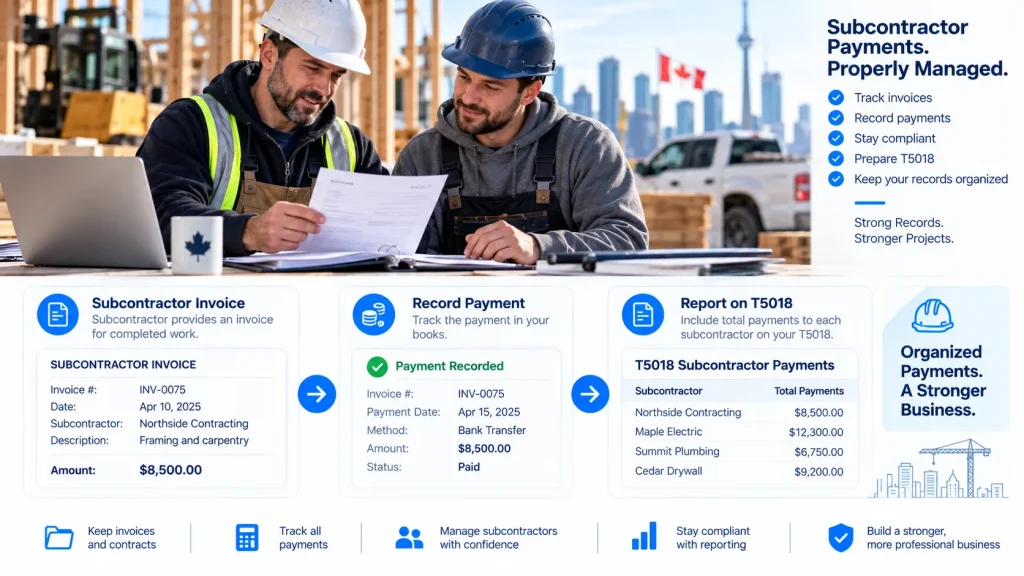
If you operate a business in Canada’s construction, renovation, or building trades and hire other tradespeople or specialists to help complete jobs, you are subject to specialized reporting rules from the Canada Revenue Agency (CRA).
A frequent bookkeeping error among general contractors, electricians, plumbers, and renovators is treating subcontractor payouts as simple, untracked cash or e-transfer transactions. Many business owners assume that because a sub-trade sent an invoice and accepted payment, the reporting responsibility ends there.
Under Canadian tax law, hiring independent sub-trades triggers mandatory annual information filings. Failing to track subcontractor data throughout the year exposes your business to automatic daily fines, audit reassessments, and severe worker misclassification penalties.
The Contractor Reporting Program Mandate ($500+ CAD Threshold)
Under the CRA’s Contractor Reporting Program, any business where construction is the primary source of business income (over 50% of total revenue) is legally required to report payments made to subcontractors.
T5018 Reporting Threshold Rule
Requirement
More than $500 in payments to a subcontractor during the reporting period, excluding GST/HST.
A T5018 information return slip must be issued for construction services during the reporting period.
Construction businesses should keep subcontractor payment records organized throughout the year.
What Counts as Construction Services: The CRA defines construction broadly, covering residential framing, drywalling, roofing, electrical work, plumbing, painting, masonry, HVAC, excavation, and structural renovation.
The $500 Threshold: If the cumulative payments to a single sub-trade reach $500 CAD or more (including GST/HST) in your reporting period, you must file a T5018 slip for that individual or corporation.
Incorporation Does Not Exempt the Subcontractor: A common misconception is that incorporated sub-trades do not need a T5018. The CRA requires T5018 slips for all subcontractors providing construction services, whether they operate as sole proprietors, partnerships, or incorporated companies.
Filing Deadlines and Daily Non-Filing Penalties
Your T5018 information return and summary are due six months after the end of your reporting period. You can elect to report on a calendar-year basis (due June 30) or aligned with your corporate fiscal year-end.
Late or incorrect information returns can result in CRA penalties. The amount depends on the number of slips and the applicable filing rules, which is why subcontractor payments should be tracked throughout the year rather than reconstructed at the deadline.
Worker Misclassification Risk: Employee vs. Independent Contractor
A related and costly compliance trap is misclassifying regular workers as independent subcontractors to avoid paying employer Canada Pension Plan (CPP) contributions, Employment Insurance (EI) premiums, and Workers’ Compensation (WSIB) board levies.
The CRA does not determine worker status based on job titles or written contracts alone. During a payroll audit, the CRA applies a strict four-factor legal test:
CRA Worker Status Test (RC4110)
Key Question
1. Level of Control
Who decides how, when, and where the work is done?
2. Ownership of Tools
Does the worker supply their own heavy tools and equipment?
3. Subcontracting Rights
Can the worker hire others to complete the task?
4. Financial Risk & Profit
Can the worker experience a genuine financial loss?
If the CRA audits your books and reclassifies a purported subcontractor as a disguised employee, the financial consequences fall on the hiring business.
The employer becomes retroactively liable for 100% of the unremitted CPP and EI premiums (both the employer and employee portions), accompanied by a 10% to 20% late-remittance penalty and daily compounding interest.
The Actionable Fix: Implement a Pre-Payment Subcontractor Onboarding Process
Never issue a deposit, progress draw, or final payment to a new subcontractor without collecting their administrative and tax details up front. Trying to track down Social Insurance Numbers or Business Numbers months later when a sub-trade has moved on is nearly impossible.
✓
Legal Identity & Address
Full legal name, operating trade name, and physical business mailing address.
✓
Tax Identification Number
9-digit CRA Business Number (BN) for corporations, or SIN for sole proprietors.
✓
Workers’ Compensation Clearance
Current WSIB or provincial equivalent clearance certificate verifying good standing.
✓
Itemized Invoice with GST/HST
An official invoice showing applicable sales tax and matching the legal vendor name.
Mistake 7: Claiming 100% of Meals and Client Entertainment
Grabbing coffee with a subcontractor at Tim Hortons, buying lunch on the road between client job sites, or taking a prospective corporate client out for dinner are routine parts of doing business.
However, a frequent error on Form T2125 (Line 8523) and corporate Schedule 125 (GIFI 8523) is deducting 100% of these food and beverage expenses.
Under Canadian tax law, meals and entertainment are subject to strict statutory restrictions. The Canada Revenue Agency (CRA) presumes that food and beverages carry a personal consumption element. As a result, claiming the full invoice total on your tax return artificially understates your net income and invites swift reassessments during a desk audit.
The 50% Add-Back Rule: How CRA Line 8523 Works
Under Subsection 67.1(1) of the Income Tax Act, the maximum allowable deduction for business-related food, beverages, and entertainment is capped at 50% of the actual amount paid.
CRA Meals & Entertainment Calculation
Amount
Total Client Dinner Bill (with Tip)
$180 CAD
Allowable CRA Tax Deduction (50% Maximum)
$90 CAD
Non-Deductible Portion (Added Back)
$90 CAD
When completing your taxes:
Sole Proprietors: On Form T2125 (Part 5, Line 8523), you enter the total gross amount spent on meals and entertainment in the left column, calculate 50%, and claim only the net 50% allowable amount in the right-hand column against your business income.
Incorporated Contractors: On corporate financial statements, 100% of the meal is recorded as an accounting expense, but your corporate tax accountant must make a Schedule 1 Net Income Adjustment on your T2 return to add back the non-deductible 50% portion to your taxable corporate income.
The Overlooked GST/HST ITC Restriction
The 50% rule also applies to sales tax recovery. Under the Excise Tax Act, you can only claim 50% of the GST/HST paid on eligible meals and entertainment as an Input Tax Credit (ITC). If you claim 100% of the sales tax paid on restaurant tabs on your GST/HST return, the CRA will disallow the excess 50% during a sales tax audit.
Keep Enough Detail to Support the Expense
For business meals, keep the itemized receipt and record the business purpose while it is still fresh.
A useful note can include:
Who attended
Their business relationship
Why the meeting took place
What business matter was discussed
For ordinary business meals, the general tax deduction is limited to 50%, although specific exceptions can apply. See the CRA guidance on meals and entertainment expenses for the current rules.
Genuine Exceptions: When Meals Are 100% Deductible
While the 50% limitation applies to standard business lunches and coffee meetings, the Income Tax Act provides specific statutory exceptions under Subsection 67.1(2) where food and entertainment are 100% deductible:
The Actionable Fix: Separate Categories and Point-of-Sale Notes
To eliminate meal deduction errors without adding manual spreadsheet work:
Use a Dedicated “Meals & Entertainment (50%)” Category: Tag all client dining, coffee meetings, and promotional meals under a specific category so your bookkeeping system or tax preparer automatically applies the 50% income tax limit and 50% ITC calculation.
Write Attendee Details on the Receipt Image: When you photograph your restaurant bill, use your app’s note field to record who attended and the commercial purpose before saving the digital slip.
Do Not Claim Solo Daily Lunches: Unless you are traveling out of town overnight on a verified business trip (away from your metropolitan area for at least 24 hours), exclude everyday lunches and coffee runs from your business records.
Special Issue for Incorporated Contractors: A Dormant Corporation May Still Have Filing Obligations
A corporation does not automatically stop having tax or corporate reporting obligations simply because it has little or no revenue.
A Canadian resident corporation generally has to file a T2 return every year, even when it is inactive or no tax is payable. See the CRA T2 filing requirements for the official rules.
The practical lesson: if you incorporated and then stopped operating, do not assume you can simply ignore the corporation until you start earning again. Check your T2 and corporate filing obligations for each year.
This is especially important for contractors who incorporated for a project and later stopped taking contracts.
Mistake 8: Never Reviewing Your Books for Errors
Recording transactions is only half the job. If you never review your books, small mistakes can stay hidden for months.
Common problems include:
Duplicate transactions
Missing expenses
Incorrect categories
Unrecorded income
Missing GST/HST details
Transactions that were entered twice or not entered at all
A short monthly review can catch problems while they are still easy to fix.
A widespread misconception among Canadian incorporated contractors and consultants is that a corporation with zero revenue has no tax filing obligations.
Contractors frequently set up an incorporated business entity that sits dormant for months, or step away from active consulting to take a temporary payroll role while keeping their corporate charter open. Many assume that because the company had no sales, paid no expenses, and conducted no banking activity, the Canada Revenue Agency (CRA) simply ignores it until operations resume.
In Canada, corporate tax filing is mandatory regardless of financial activity.
Under Subsection 150(1) of the Income Tax Act, every corporation resident in Canada whether active, dormant, pre-revenue, or operating at a net loss must file an annual T2 Corporate Income Tax Return within six months of its fiscal year-end date. Inactivity does not exempt you from filing compliance.
Inactive Corporation Filing Myth
Result
“Zero Revenue = No Tax Form”
❌ FALSE — Non-filing can result in penalties
Annual T2 Return Mandatory?
✅ TRUE — Generally required every year from the date of incorporation
The Compounding Costs of Non-Filing and Inaction
The CRA does not base filing requirements on cash flow or bank balances. Once a Certificate of Incorporation is issued, the corporation exists as a separate legal person with its own independent tax reporting duties.
Ignoring an inactive corporation triggers serious statutory consequences:
Failure-to-File Penalties under Subsection 162(7): If the CRA issues a formal Demand to File and you ignore it, the CRA can assess a penalty of $25 per day, up to a maximum of $2,500 per return. This penalty applies even when zero tax is owing. If a corporation remains dormant for three years without filing, non-filing penalties alone can reach $7,500 CAD on a company that never earned a dollar.
Mandatory Electronic Filing Penalty: Canadian corporations are legally required to e-file their T2 returns. Attempting to submit delinquent paper returns can trigger an automatic $1,000 non-compliance penalty.
Administrative Corporate Dissolution: If an incorporated entity fails to file its annual corporate tax returns and annual corporate registry returns (such as Corporations Canada or Ontario Form 1), the government will initiate administrative dissolution proceedings. Once dissolved, the company legally ceases to exist, corporate bank accounts can be frozen, and the liability shield protecting your personal assets is invalidated.
What Is a T2 Nil Return?
A T2 Nil Return (often filed using simplified schedules or a T2 Short Return) is a complete, formal corporate tax filing submitted to the CRA declaring that the corporation had $0 in gross revenue and $0 in deductible expenses during the fiscal year.
When you submit a T2 Nil Return, you are formally verifying:
The corporation existed during the specific reporting period.
The company’s Balance Sheet and General Index of Financial Information (Schedule 125 GIFI) accurately reflect the beginning and ending asset or equity balances.
No taxable income was earned, and all reporting duties remain up to date.
Even though no tax is payable, filing the T2 Nil Return keeps your CRA business number in good standing, prevents demand notices, and preserves the corporation’s active status.
The Actionable Fix: Prepare and E-File a Clean T2 Nil Return
If you have a corporation that had no financial activity during its fiscal year, do not let deadlines pass unnoticed.
Identify Your Fiscal Year-End: Your T2 return is due exactly six months after your incorporation fiscal year-end (for example, a company with a December 31 year-end must file by June 30).
E-File via Certified Software: E-file your simplified return through CRA-approved corporate tax software or have a licensed CPA file it on your behalf.
Maintain Provincial Registry Filings: Ensure your annual corporate information return is filed with your provincial or federal corporate registry alongside your T2 return to avoid administrative cancellation.
Mistake 9: Letting Receipts Pile Up for Year-End Reconstruction (“Shoebox Syndrome”)
Almost every contractor starts the fiscal year with good intentions. You create a new spreadsheet, set up folders in your email, and resolve to record every single expense.
By week four, project deadlines hit, sub-trades need immediate direction, materials must be picked up across town, and that bookkeeping routine collapses.
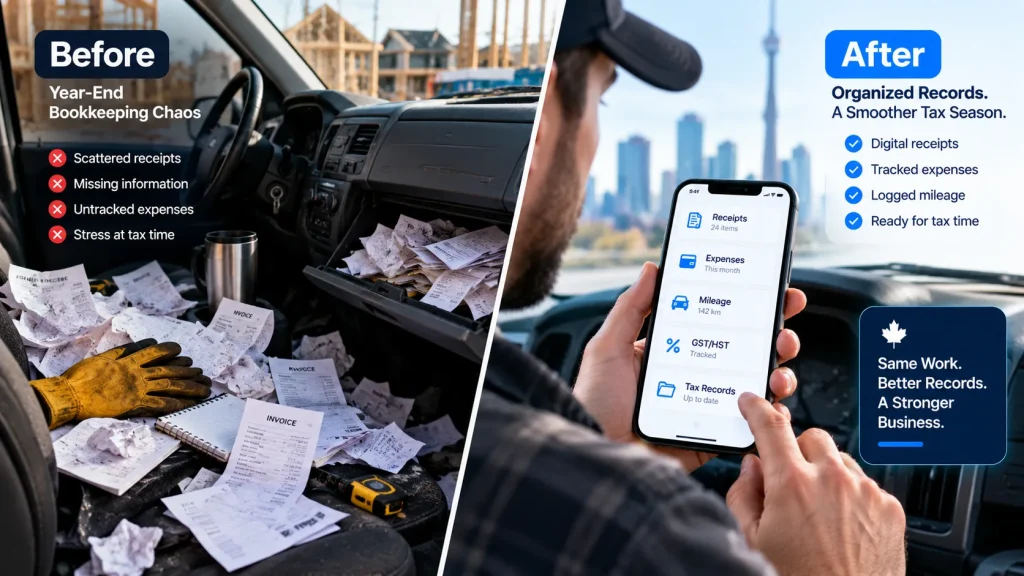
What follows is the single most common and costly habit in the Canadian contracting sector: Shoebox Bookkeeping Syndrome. Receipts get tossed onto the truck dashboard, stuffed into glove compartments, or left scattered across digital inboxes. When tax season arrives in April or June, business owners face a stressful, high-stakes marathon trying to reconstruct twelve months of financial history over a single weekend.
Moving from scattered receipts to organized digital records can make year-round bookkeeping easier.
Annual financial reconstruction is not just exhausting; it is an expensive financial leak that costs contractors thousands of dollars in lost deductions, inflated accounting bills, and avoidable Canada Revenue Agency (CRA) interest charges.
Why Manual Bookkeeping Falls Behind
Spreadsheets are flexible and inexpensive, but they depend on you remembering to update them consistently.
That is where many busy contractors get stuck. A receipt that takes a few seconds to record today can take much longer to reconstruct six months later.
The longer bookkeeping is delayed, the harder it becomes to remember what a purchase was for, where the receipt is, and whether the transaction included GST/HST.
When you manage books manually, you are forced to re-type dates, vendor names, line items, and sales tax numbers from crumpled paper slips. The moment a busy work stretch occurs, data entry falls behind. Once a backlog reaches two or three months, the time required to catch up feels insurmountable, guaranteeing that records sit untouched until the tax filing deadline looms.
Why Delayed Bookkeeping Creates Problems
The longer you wait, the harder it becomes to remember why a transaction was business-related and what you actually purchased.
A bank transaction from eight months ago may tell you that you spent $84.50 at Canadian Tire, but it may not remind you whether you bought job-site materials, office supplies, or something personal.
Recording the expense while the details are fresh is much easier than reconstructing the story later.
Ignoring Cash Flow Until Tax Season
A profitable business can still run short of cash.
You may have $20,000 of invoices outstanding while also needing cash for subcontractors, fuel, materials, GST/HST, and tax payments.
If you only look at your books once a year, you may not notice the problem until the cash is already tight.
Review your income, outstanding invoices, major expenses, GST/HST position, and upcoming tax obligations regularly so you know what cash is actually available.
Cash Flow Blindness: Operating Without Financial Visibility
When you only examine your numbers once a year at tax time, you are operating your business in total financial darkness.
Annual-only bookkeeping creates three severe operational risks:
Untracked Net Margins: You cannot tell which client jobs or service contracts were truly profitable after factoring in materials, vehicle travel, and sub-trade labour.
Surprise Corporate and Personal Tax Bills: When profitable contractors do not monitor their net taxable income during the year, they fail to set aside adequate cash reserves, resulting in severe cash crunches when tax balances come due.
Unexpected CRA Tax Installment Demands: If your net tax payable exceeds $3,000 CAD in the current year and either of the two preceding years, the CRA legally mandates that you pay your taxes in quarterly installments. Operating with outdated books leaves you unprepared for these mandatory installment payments, triggering automatic CRA installment interest and penalties under Section 163.1 of the Income Tax Act.
The Hidden Financial Drain: CPA Reconstruction Rates
When you hand an unorganized box of paper slips, loose digital files, and unreconciled bank statements to an accounting firm in March, the CPA is no longer performing standard tax filing. They are performing emergency forensic financial reconstruction.
Professional Hourly Rates: Canadian CPAs and specialized accounting firms bill clean-up work at $150 to $250+ per hour (or standard bookkeeper clean-up at $50 to $90/hour).
Clean-Up Timelines: Sorting, verifying, cross-referencing, and categorizing twelve months of messy transactions takes between 15 and 35 hours of professional labour.
The Bottom Line: You end up paying thousands of dollars for basic administrative sorting that could have been handled automatically throughout the year.
The Actionable Fix: The 20-Second “Snap-and-Tag” Workflow
You do not need to spend hours at a desk every weekend to maintain pristine books. The secret to effortless record-keeping is shifting data entry to the exact moment the purchase happens.
Expense Capture Workflow
Action
Supplier Counter
Pay for materials or fuel
10 Seconds
Snap a photo of the itemized paper receipt
10 Seconds
Select the CRA category: Materials, Fuel, or Tools
Result
Expense archived in the cloud and retained for tax records
Capture Before Leaving the Parking Lot: Take 20 seconds while sitting in your vehicle at the supplier parking lot to snap a photo of the receipt using a mobile bookkeeping app.
Let OCR Extract the Data: Optical Character Recognition (OCR) technology automatically extracts the date, vendor, total cost, and GST/HST paid.
Select the CRA Category Immediately: Assign the expense to standard tax categories (Materials, Subcontractors, Tools, Fuel, or Vehicle Maintenance) while the project context is completely fresh in your mind.
Ditch the Paper: Once the digital image is stored in a CRA-compliant digital cloud archive, the proof is secure for the mandatory six-year retention period, eliminating shoeboxes forever.
Mistake 10: Overpaying for Bloated Accounting Software with Paywalls
When bookkeeping software becomes more complicated than the business itself, owners often stop using it consistently.
Solo contractors usually need a simple way to:
Record income and expenses
Capture receipts
Track mileage
Track GST/HST
Keep records organized
Prepare information for tax time
A system with more features is not automatically a better system. The best bookkeeping system is one you will actually keep up with.
Before choosing software, ask:
Can I understand it without accounting training?
Can I record expenses quickly?
Can I keep receipts with transactions?
Can I track the information relevant to Canadian taxes?
Will I still use it six months from now?
For a small business, consistency is often more valuable than complexity.
The 4-Step Audit-Proof Routine for Canadian Contractors
Maintaining clean, audit-proof books does not require spending four hours every Sunday wrestling with spreadsheets or deciphering double-entry general ledgers.
The secret to effortless bookkeeping is shifting administrative record-keeping from an annual emergency to a frictionless, 30-second daily routine. When you capture financial data at the point of sale, your records stay accurate in real time, and tax season transforms from a chaotic ordeal into a simple one-click export.
Follow this simple, four-step routine to protect your business deductions and keep the Canada Revenue Agency (CRA) satisfied.
Step 1
Clean Separation
Route business income and expenses through dedicated business
accounts. Keep personal purchases and subscriptions separate
from business transactions.
Frequency: Set Up Once
Step 2
Instant Snap & Tag
Photograph paper receipts as soon as practical after purchase.
Categorize the expense and record applicable GST/HST details
while the transaction is still fresh.
Frequency: About 20 Sec. Per Receipt
Step 3
Mobile Trip Logging
Record the date, destination, distance, and business purpose
of each qualifying trip as soon as practical. Maintain a
contemporaneous vehicle log to support your motor vehicle claim.
Frequency: Each Business Trip
Step 4
Tax-Ready Exports
Generate organized expense and income reports for your
accountant or tax return preparation. Export records in a
format that supports the applicable business tax schedules.
The foundation of audit-proof record-keeping is establishing a strict financial boundary on day one.
Open Dedicated Accounts: Set up a commercial chequing account and a dedicated business credit card. All client retainers, progress payments, and trade disbursements must flow exclusively through these accounts.
Stop Using Personal Cards for Routine Supplies: Swiping a personal card for minor hardware or fuel purchases creates an immediate paper trail break.
Standardize Owner Transfers: If you need to withdraw profits, execute a single electronic transfer to your personal account clearly categorized as an Owner Draw (for sole proprietors) or processed through formal payroll or dividends (for incorporated directors).
Step 2: Instant Capture (The Point-of-Sale Snap-and-Tag)
Thermal receipt paper degrades quickly in vehicle consoles and toolboxes. By the time tax season arrives, months of valuable tax deductions can fade into blank slips of paper.
Capture Before Leaving the Supplier: Never leave the store parking lot without taking a clear photo of the paper receipt using a mobile receipt scanner.
Extract Critical Metadata: Verify that the digital image captures the date, vendor name, itemized product list, 9-digit CRA Business Number (BN), and separated GST/HST amount.
Tag the CRA Category Immediately: Assign the expense to its corresponding tax line (such as Materials, Small Tools, or Subcontractors) while the commercial project context is completely fresh.
Step 3: On-the-Go Digital Mileage Logging
Because vehicle expenses are heavily scrutinized during CRA reviews, maintaining a trip log as you drive is essential to defending your deduction.
Log Trips as They Happen: Record your destination, client name, and business objective when you turn off the vehicle. Attempting to recreate twelve months of driving using calendar invites or Google Maps history at tax time often results in errors that raise audit flags.
Record Year-End Odometer Checkpoints: Photograph your vehicle dashboard odometer on January 1 and December 31 of every year to verify total annual kilometers driven.
Track the Business-Use Percentage: Let your software automatically compare business kilometers against total vehicle travel to calculate your allowable vehicle expense deductions accurately.
The ultimate goal of daily record-keeping is making tax season seamless for you and your accountant.
Sole Proprietors (Form T2125): Your bookkeeping tool should export a summary that matches the exact line numbers on CRA Form T2125 (Statement of Business or Professional Activities), including Line 8521 (Advertising), Line 8523 (Meals & Entertainment [50%]), Line 8810 (Office Expenses), Line 8871 (Subcontractors), and Line 9281 (Motor Vehicle).
Incorporated Contractors (T2 Corporate Filings): Ensure your financial records export directly into Schedule 125 General Index of Financial Information (GIFI) codes, allowing your corporate tax accountant to prepare your T2 return without expensive manual clean-up fees.
GST/HST Remittance Summary: Export a dedicated report showing total taxable sales, total GST/HST collected, and total eligible Input Tax Credits (ITCs) claimed, making sales tax filing effortless.
A Simple Monthly Bookkeeping Check
You do not need hours of bookkeeping every week. A short monthly review can help keep your records under control.
Check your income: Make sure invoices, payments, and other business income are recorded.
Check your expenses: Review uncategorized transactions and missing receipts.
Check GST/HST: Review tax collected and eligible ITCs.
Check mileage: Make sure recent business trips are recorded.
Check for errors: Look for duplicates, missing transactions, or unusual amounts.
This small monthly habit is much easier than reconstructing a full year of bookkeeping at tax time.
How Zoombooks Helps Prevent These Bookkeeping Mistakes
Managing your finances as an independent contractor or consultant should not feel like taking on a second unpaid job. You do not need an enterprise accounting ledger, confusing journal entries, or expensive monthly software subscriptions designed for multinational corporations.
What you need is a simple bookkeeping app for Canadian contractors that gets out of your way, captures your deductions accurately in real time, and ensures your tax filings are completely audit-proof.
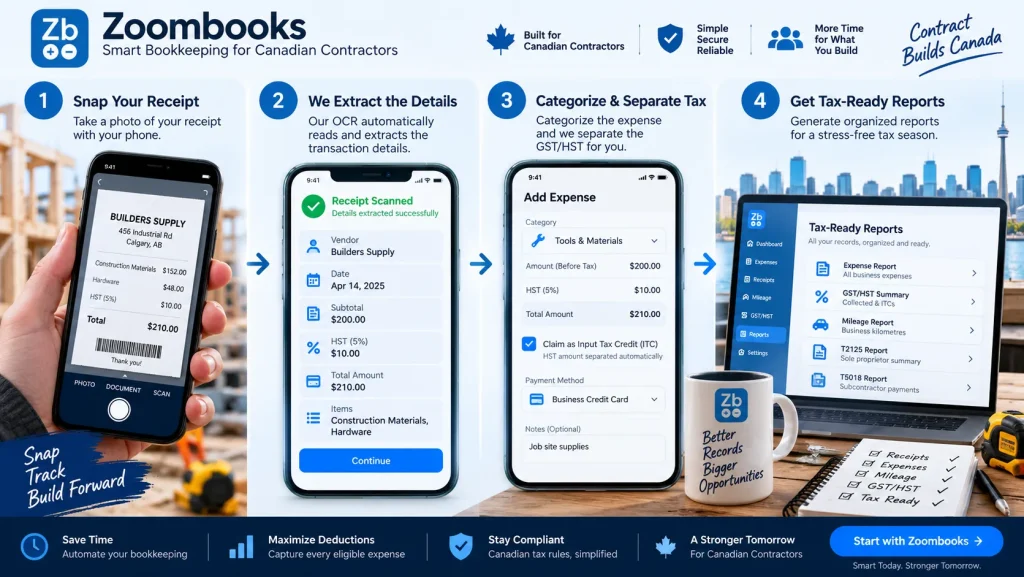
Zoombooks streamlines the bookkeeping workflow from receipt capture to organized, tax-ready records.
Zero Accounting Background Needed: Eliminating Double-Entry Headaches
Traditional accounting software forces solo business owners into the role of a certified general bookkeeper. You are expected to set up complex chart of accounts hierarchies, reconcile mismatched bank feeds, and diagnose balance sheet discrepancies.
Zoombooks replaces that complexity with an intuitive Snap-and-Tag system built from the ground up by Canadian tax accountants at Instaccountant:
No Double-Entry Mechanics: Never worry about debits, credits, or journal entries.
Real-Time Tax Separation: Photograph a receipt, and the app automatically extracts the net cost and separates the GST/HST paid so your Input Tax Credits (ITCs) are secured instantly.
Native CRA Form Alignment: Expenses are organized directly into the official categories required on Form T2125 (Statement of Business or Professional Activities) and corporate Schedule 125 (GIFI).
Zoombooks Workflow Advantage
Action
1. Snap the Receipt
Photograph the receipt in your truck or at the point of purchase.
2. Automatic OCR
OCR extracts key details such as the date, vendor, total, and GST/HST.
3. Select Trade Category
Categorize the expense as Materials, Fuel, Tools, or another applicable category.
4. Export Tax-Ready Reports
Generate organized reports for your accountant and year-end tax preparation.
Cross-Platform Access: Mobile Capture with Web Dashboard Power
Contractor bookkeeping happens in two places: on the road and at your desk. Zoombooks is built to keep both in sync:
Mobile App (iOS & Android): Capture receipts in the supplier parking lot, record client site travel with the built-in CRA mileage logbook, and check your net GST/HST liability right from your smartphone.
Web Dashboard: Access your full financial history on your desktop, manage job tags, review quarterly revenue trends, and download clean CSV or PDF reports to hand directly to your CPA.
Audit-Proof 6-Year Cloud Archive: Every digital receipt image and mileage log is safely preserved in compliance with the CRA’s mandatory six-year record retention rule.
Transparent Canadian Pricing with Zero Feature Paywalls
Unlike competitors that hide receipt scanning, mileage tracking, or tax summaries behind upper-tier subscriptions costing $28 to $80+ per month, Zoombooks offers flat, transparent pricing designed specifically for Canadian micro-businesses.
Every plan includes ALL core features: Receipt scanning OCR, CRA vehicle mileage tracking, real-time GST/HST and ITC monitoring, job tagging, and native T2125/T2 exports.
Starter Tier ($0 / Free Forever): Includes 30 free receipt scans with unlimited manual expense logging, making it a free starting option for Canadian contractors who want to begin organizing their bookkeeping.
Smart Plan ($11 CAD / month): Full contractor features with 40 automated receipt scans per month less than half the price of QuickBooks Online EasyStart.
Professional CPA Advisory
Tangled Personal & Business Expenses? Fix Backlogs Before the CRA Flags Them.
If you have months or years of mixed accounts, overdrawn shareholder loans, or unfiled corporate returns, don’t guess your way through tax season. Our parent CPA firm, Instaccountant, specializes in clean-up bookkeeping and Section 15(2) tax defense for Canadian contractors.
📍 Based in Toronto, ON•⚖️ Full CRA Audit Representation•💼 T2 Corporate Specialists
Frequently Asked Questions About Small Business Bookkeeping Mistakes in Canada
What is the most common small business bookkeeping mistake?
One of the most common problems is mixing personal and business transactions. It makes legitimate business expenses harder to identify, increases cleanup work, and can create problems when preparing tax returns. The best fix is to separate business spending, keep supporting documents, and update your records regularly.
Can the CRA audit or disallow my expenses if I have complete bank and credit card statements?
Yes. During a desk audit or expense verification review, the CRA routinely disallows business deductions supported solely by bank feeds, Visa statements, or cancelled cheques. Under Subsection 230(4) of the Income Tax Act, a bank statement only proves that money left your account it does not prove what you bought, why it was purchased for commercial operations, or whether GST/HST was charged. To defend a deduction, you must produce the original itemized vendor receipt or bill of sale showing: The vendor’s legal trade name and physical address The exact transaction date An itemized breakdown of the goods or services purchased The vendor’s 9-digit CRA Business Number (mandatory for claiming Input Tax Credits) The separate subtotal, sales tax (GST/HST), and total paid
How long do Canadian contractors legally need to keep receipts and bookkeeping records?
Under CRA regulations, you are legally required to retain all supporting tax documentation, paper receipts, digital scans, bank statements, client invoices, and mileage logs for six years from the end of the tax year to which they relate. For example, supporting documents for a return covering the 2026 tax year must be preserved until December 31, 2032. If you file a return late, the mandatory six-year retention clock begins on the actual date the return was submitted, not the original filing deadline. The CRA fully accepts digital copies and mobile scans as primary source records, provided the images are clear, legible, and produced in a readable electronic format upon request.
How does the CRA $30,000 small supplier threshold for GST/HST actually work?
You are classified as a “small supplier” and not legally required to register for or charge GST/HST as long as your gross worldwide taxable revenue remains at or below $30,000 CAD over a single calendar quarter or across four consecutive calendar quarters (a rolling 12-month period). The threshold does not reset automatically on January 1 of each calendar year: Single Quarter Spike: If your business bills $32,000 in a single calendar quarter (e.g., April 1 to June 30), you cease to be a small supplier immediately on the day the threshold-crossing transaction occurs. You must register and charge GST/HST on that specific invoice. 4-Quarter Accumulation: If your gross billings reach $30,001 across four consecutive quarters (e.g., Q3 2025 through Q2 2026), you cease to be a small supplier at the end of the month following the fourth quarter, and must collect tax starting the next day.
What is the difference between current operating expenses and capital expenses (CCA) for taxes?
The distinction comes down to the lasting economic life of the purchase: Current Operating Expenses: Routine operational costs consumed quickly to keep the business running day-to-day (fuel, sandpaper, job-site consumables, phone plans, software subscriptions). These are 100% deductible in the year they are incurred. Capital Expenses (Capital Cost Allowance – CCA): Durable equipment, computers, vehicles, and machinery that provide value across multiple years. These cannot be written off in full in year one; they must be added to your balance sheet and depreciated over time using CRA-prescribed CCA rates (e.g., Class 50 at 55% for laptops and computer hardware; Class 8 at 20% for trade tools and machinery costing $500 or more; Class 10/10.1 at 30% for motor vehicles).
What happens if an incorporated contractor uses a corporate bank account for personal expenses?
When an incorporated director uses corporate funds to pay for personal groceries, home renovations, or vacations, the CRA classifies those withdrawals as an overdrawn Shareholder Loan. Under Section 15(2) of the Income Tax Act, if a shareholder loan is not fully repaid to the corporation within one year from the end of the corporate fiscal year in which it was drawn, the entire outstanding balance is added directly to the director’s personal taxable income. You pay personal income tax on the withdrawal at your marginal rate, the corporation receives zero tax deduction, and the CRA may assess additional deemed interest benefit penalties under Section 80.4.
What are the mandatory requirements for a CRA-compliant vehicle mileage log?
The CRA strictly rejects flat-rate percentage estimates (such as claiming “80% business use” without documentation). If audited, the CRA can disallow 100% of your vehicle operating expenses and Capital Cost Allowance. To support a motor vehicle deduction on Form T2125 or corporate Schedule 125, your log must record: Date of each commercial trip Destination address Specific business purpose (e.g., “Rough-in inspection – Apex Commercial Site”) Distance traveled in kilometers Total vehicle odometer reading at the start (Jan 1) and end (Dec 31) of the fiscal year
Do I have to file a T2 corporate tax return if my corporation was dormant or earned $0?
Yes. Under Subsection 150(1) of the Income Tax Act, every corporation resident in Canada must file an annual T2 Corporate Income Tax Return, even if it had $0 in revenue, zero operational expenses, and held no active bank accounts during the fiscal year. This filing is known as a T2 Nil Return. Failing to file an inactive return within six months of your fiscal year-end triggers CRA failure-to-file penalties under Subsection 162(7) of $25 per day up to a maximum of $2,500 per return, even when no tax is owed. Neglecting inactive filings can also lead provincial or federal corporate registries to administratively dissolve your company.
Written By
Muhammad Muzammil
WordPress Developer & SEO Content Strategist
Muhammad Muzammil combines technical WordPress architecture,
Core Web Vitals optimization, and topic clustering to build
organic growth systems for SMBs and fintech platforms. With
over 100 web projects delivered, he translates complex
small-business topics and Canadian tax workflows into
accessible, search-optimized guides.
Based in Toronto, Ontario, Murtaza is a finance and technology
leader with over two decades of accounting, audit, and ERP
implementation experience (ex-PricewaterhouseCoopers, ACA/ICAP,
ACCA). As CEO of Instaccountant and Founder of
Zoombooks.app, he designs CRA-aligned bookkeeping
and expense-tracking solutions for Canadian contractors and
self-employed professionals.
Zoombooks is a Canadian bookkeeping and receipt-scanning app developed by accountants to help freelancers and contractors automate expenses, track GST/HST ITCs, and stay 100% CRA audit-proof.